If you’ve only caught the preview clips so far, here’s what’s actually happened.
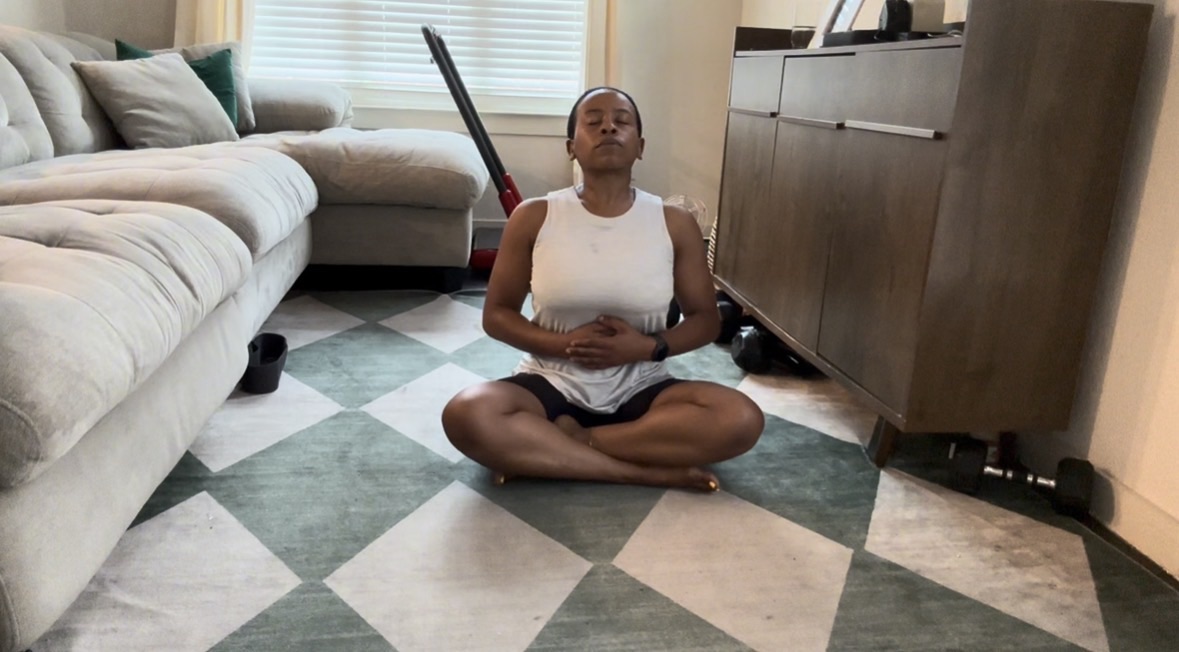
Two Thursdays ago, I started something I hadn’t done before on on my YouTube Channel: an 8-week restart, filmed in real time, in my actual living room, before my son and husband are even awake (most of the time). Not a challenge. Not a transformation series. Just eight weeks of showing up for a body that’s going through something nobody handed me a manual for.
Week 1: The Restart
The first episode wasn’t about a workout plan. It was about naming the thing underneath it that the exhaustion a lot of us feel isn’t a discipline problem. Something in the body changed, and nobody told us the plan needed to change with it.
We kept the movement small on purpose. A 15-minute low-impact reset. Nothing that spikes you when you’re already running on empty. The point of Week 1 wasn’t intensity. It was proof that showing up, even in a small way, still counts.
Week 2: Feeding the Muscle You’re Trying to Build
By Week 2, I was doing the strength work and still felt soft and tired, and it took me a minute to realize why. I was building muscle and not feeding it.
So Episode 2 wasn’t a diet video; it was the other half of the equation. During perimenopause, your body holds onto muscle differently than it used to, and it needs more support to do it. Not a scary stat. Just context for why this feels harder than it did at 30.
What actually changed for me wasn’t a system. It was small things like adding almonds to whatever I was already making instead of building a separate meal, keeping one thing pre-made in the fridge so there’s no decision left to make at the end of a long day. The reframe underneath all of it: this isn’t about eating perfectly. It’s about giving the muscle you’re already building something to work with.
The workout that paired with it; 20-minute full-body strength session with dumbbells or bodyweight only was the “feed the muscle” follow-through.
Where We Are Now
Two weeks in, the pattern is already familiar to anyone who’s tried to rebuild something while life keeps happening around it: show up small, notice what your body actually needs, adjust, keep going. Not a straight line. Just consistent.
If you’re standing at the very beginning of this; the “I don’t even know where to start” part; that’s exactly what the Midlife Rebuild Starter Guide is for. Ni pressure, no plan to fail, just a gentle way back into movement for the body you actually have right now.
Week 3 airs this Thursday and we’re talking about the 10 minutes you actually have, not the hour you don’t.
Watch the series so far:
Episode 1: The Restart
Episode 2: Feeding the Muscle You’re Trying to Build
The shift that made consistency feel possible for the first time in years.
I stepped on the scale on a Tuesday morning, and I’d gained weight.
I’d worked every day that week. I’d slept better than I had in months. I felt genuinely good…strong, even. And then that number erased all of it in about three seconds.
I’ve always stayed away from the scale in the past. I learned a long time ago that the scale doesn’t dictate how well you’re doing in your fitness journey. But I had just gotten a new fitness watch and I wanted to make sure it provided accurate information which meant I had to enter my weight.
If you’ve been in perimenopause for more than five minutes, you probably know this exact feeling. The scale stops telling you anything useful but it still has enormous power over how you feel about yourself.
That Tuesday was the last time I weighed myself.
Here’s what I learned, what I track instead, and why it changed everything about how I show up for movement.
Why the Scale Stops Working in Perimenopause
This isn’t a mindset problem. There’s actual physiology behind it.
During perimenopause, fluctuating estrogen affects water retention, fat distribution, and how your muscles respond to training. You can be building genuine strength, improving your insulin sensitivity, and reducing inflammation which is all real, meaningful progress but the scale shows a number that looks exactly the same or higher than last month.
The scale also doesn’t account for:
• Muscle you’re building (muscle is denser than fat so gaining it can show as weight gain even as your body composition improves)
• Hormonal water retention (can swing 3–5 lbs in 24 hours with no change in behavior)
• Sleep quality improvements (measurable metabolic benefit that won’t show on the scale)
• Cortisol regulation from consistent movement (enormous during perimenopause but invisible on the scale)
The scale isn’t lying. It’s just measuring the wrong thing.
The 4 Things I Track Instead
None of these require an app. None of them require a number. All of them tell me more about how my body is actually doing than any scale ever did.
1. Consistency — Did I Show Up?
Not how hard I worked. Not how long. Just: did I show up this week?
Consistency is the foundational marker. Three workouts in a week, even if two of them were 15 minutes, is a win. I note it. I acknowledge it. I don’t dismiss it because it wasn’t harder or longer.
2. Energy — How Do I Feel by Wednesday?
This one took me a few weeks to notice. When I’m moving consistently, my energy by midweek is genuinely different. Not perfect but more steady. Less crashing at 2pm. Less dreading everything.
I rate my energy daily. It helps determine what exercise I am going to be doing for today. It’s the most revealing data point I have.
3. Strength Markers — Can I Do Something I Couldn’t Do Before?
Not a PR. Not a benchmark. Just: is something easier than it was last month?
Maybe the glute bridges that were hard in week one feel manageable now. Maybe you’re doing the reverse lunges with heavier dumbbells. Maybe you carried the groceries up the stairs without thinking about it. That’s strength. Real, functional, this-is-what-it’s-for strength.
4. Sleep — Am I Getting More of It?
Consistent movement is one of the most evidence-backed ways to improve sleep during perimenopause. Not medication. Not a protocol. Movement.
I track whether I’m sleeping through more nights, waking up less, falling back asleep more easily when I do wake. Over 4–6 weeks, the pattern becomes undeniable. The days of staying up all night and waking up early like I will be okay are over. I prioritize my sleep to give me a better chance at a productive morning workout.
✦ FREE GUIDE FOR WOMEN IN PERIMENOPAUSE
If this resonated with you, I made something for exactly this moment.
The Quiet Rebuild Starter Guide is a free 7-day gentle return-to-movement guide built specifically for women in perimenopause.
No email tricks. No pressure. Just a starting point built for the body you have right now.
What This Actually Changed
When I stopped tracking weight and started tracking these four things, something shifted.
I stopped canceling workouts because I’d “already blown it” after a bad scale day. I stopped the mental math of whether my effort was “worth it” based on a number that doesn’t reflect the real work. I started noticing things I never noticed before like that I feel different after a hard workout week. That my energy is measurably better by mid-month when I’ve been consistent. That I’m sleeping longer and waking up less panicked at 3am.
The scale was making me doubt all of hardwork before I could see the real results.
Without it, I finally got to see them.
A Note on What This Isn’t
This isn’t about avoiding the scale forever or making it wrong to use one. It’s about noticing whether the scale is working for you or against you right now.
If you step on the scale and feel neutral; note it and moved on. But if you step on the scale and it determines your entire relationship with movement for the week, it might be worth asking what you’re actually measuring for.
For most women in perimenopause I talk to, the scale has become noise. It is a loud, demoralizing noise and quieting it is what finally let them hear what their body was actually saying.
Watch This Thursday
On Thursday July 3rd I’m going deeper on this on YouTube including the exact conversation I had with myself the morning I stepped off the scale for the last time, and what I’ve been tracking since.
There’s a particular kind of exhausted that hits in your 40s that nobody really prepares you for. It’s not the tired-from-a-bad-night’s-sleep kind. It’s the woke-up-already-drained, hot-at-2am, body-feels-different-than-it-did-two-years-ago kind. The kind where you want to move your body but every workout you try feels like it was designed for someone ten years younger and three hormone cycles behind you.
I know that feeling because I’ve been in it. Just last night, I woke up five times from hot flashes. I know what the internet tells you to do: more cardio, sweat it out, push harder. I tried that and didn’t see results anymore.
But here’s what nobody told me… that advice was actually working against me because of perimenopause. The research is clear, and once I understood it, everything about how I approach my workouts changed.
The answer isn’t more cardio. Although, I still do cardio. But the real sauce is strength training. It doesn’t have to be complicated, heavy, or long.
Why Strength Training Is the Most Important Thing You Can Do During Perimenopause
Estrogen decline begins years before your last period, often in your late 30s or early 40s. Your body loses its natural muscle-preservation support system. Estrogen plays a direct role in maintaining muscle mass and bone density. When it drops, both drop with it, often faster than you’d expect.
This is why so many women in perimenopause notice weight redistribution (especially around the midsection), reduced energy, and a sense that their body composition is changing even when nothing in their diet or routine has. It’s not a willpower problem. It’s hormonal physiology.
Strength training directly addresses this. Lifting even light weights signals your body to preserve and build lean muscle, which:
• Increases your resting metabolic rate (so your body burns more calories at rest) • Supports bone density at a time when it’s most at risk • Improves insulin sensitivity, which reduces fat storage around the belly • Regulates mood and sleep through the release of endorphins and growth hormone • Reduces the severity of perimenopause symptoms over time
The research isn’t subtle on this. A 2022 study published in Menopause: The Journal of The Menopause Society found that resistance training significantly improved body composition, muscle strength, and quality of life in perimenopausal women without requiring high intensity.
Low impact does not mean low effort. It means smart effort.
What My Workouts Look Like on a Hard Hormone Day
I’ll be honest with you. There are days where a 45-minute workout is just not happening. Hot flash at 3am, my son needs things before I’ve had coffee, the general weight of everything and some days the most I can commit to is increments of 15 minutes and three moves.
Those days, this is what I do.
Three moves. Weights in hand. Done in under 20 minutes including rest. And every single one of them is directly relevant to what your body needs during perimenopause.
The 3 Moves
Dead Bug with Weights The dead bug is one of those exercises that looks gentle and absolutely is not. It’s a deep core stability exercise that protects your lower back, strengthens your transverse abdominis (the deep stabilizing muscle that wraps around your spine), and challenges coordination in a way that keeps your nervous system engaged. During perimenopause, core strength is more important than most people realize. Hormonal shifts affect ligament laxity and joint stability. your core is what compensates for that. A strong core also supports better posture, reduces back pain, and helps regulate intra-abdominal pressure. How to do it: Lie on your back with your knees bent at 90 degrees, shins parallel to the floor. Hold a light weight in each hand and extend your arms straight up toward the ceiling. Slowly lower your right arm back toward the floor while simultaneously extending your left leg straight out — hovering both just above the ground. Return to center. Then lower your left arm and right leg. That’s one rep. Go slow. The slower you go, the harder it works. Keep your lower back pressed into the mat throughout. Equipment: Light dumbbells, 3–8 lbs depending on where you are. Amazon — Bowflex SelectTech Adjustable Dumbbells or CAP Barbell Neoprene Dumbbell Set
Alternating Reverse Lunge with Weights The reverse lunge is a single-leg movement, which means it trains balance, hip stability, and unilateral (one-sided) strength simultaneously. For perimenopausal women, this is crucial — single-leg movements help prevent the muscle imbalances that can lead to knee and hip problems as we age. The reverse lunge is also significantly more joint-friendly than a forward lunge. The movement pattern reduces shear force on the knee, making it accessible even on days when your joints feel sore or inflamed (which, thanks to estrogen’s anti-inflammatory role declining, is more common in perimenopause than most people expect). Lower body strength is your metabolic engine. The more muscle you have in your legs and glutes, the higher your resting metabolic rate — and the more effectively your body manages blood sugar and weight. How to do it: Stand tall holding a weight in each hand at your sides. Step your right foot back and lower your right knee toward the floor, keeping your front shin as vertical as possible and your chest up. Press through your left heel to return to standing, then bring your right foot back to meet your left. Alternate sides with each rep. Equipment: Medium dumbbells, 8–15 lbs. Start lighter than you think you need to. Amazon — Yes4All Vinyl Coated Dumbbells or Yes4All Adjustable Dumbbells
Bent-Over Row with Weights Upper body pulling movements are criminally underrepresented in most women’s fitness content, and it costs us. The bent-over row strengthens your upper back, rear deltoids, and biceps — the muscles responsible for posture, shoulder stability, and counteracting the forward rounding that happens when we’re hunched over phones, kids, and desk work all day. During perimenopause, back health becomes even more critical as bone density in the spine begins to decline. Strengthening the muscles that support the spine directly helps protect it. Strong upper back muscles also help prevent the postural changes that become more common as estrogen drops. How to do it: Hinge forward at the hips with a soft bend in your knees, keeping your back flat and your core engaged. Let the weights hang in front of you. Drive your elbows back and up, squeezing your shoulder blades together as you pull the weights toward your lower ribcage. Lower with control. That’s one rep. Don’t rush this one. The lowering phase (the eccentric) is where a significant portion of the muscle-building stimulus happens. Equipment: Medium dumbbells, 10–20 lbs depending on your current strength. Amazon Basics Rubber Encased Hex Dumbbells or Bowflex SelectTech 552
A Sample Workout for a Hard Hormone Day This is the actual workout. No warm-up theatrics, no 47-step routine. Just movement. Do 3 rounds: • Dead Bug with Weights — 8 reps (4 each side) • Up Downs — 10 reps (5 each side) • Bent-Over Row — 10 reps • Rest 60 seconds between rounds Total time: 15–20 minutes. On a good energy day, add a fourth round or increase your weights slightly. On a low energy day, two rounds still counts. You still showed up.
What to Expect When You Start Strength Training in Perimenopause The first two to three weeks, your body is learning the movements. Don’t expect to feel dramatically different immediately. What you will notice fairly quickly is better sleep quality (strength training improves deep sleep stages), reduced anxiety, and a general sense of having done something good for yourself. Over six to eight weeks, you’ll start to notice changes in how your body feels — more stability, less joint soreness, more energy on non-workout days. The hormonal benefits compound over months, not days. Consistency is the whole game here. You don’t need to lift heavy. You don’t need to train five days a week. You need to show up consistently with weights in your hands and give your body the signal it needs: build muscle, preserve bone, stay strong.
One More Thing If you’re navigating perimenopause and trying to figure out where to start, I put together a 7-Day Gentle Reset specifically for women 40+. It’s built around the same principles as this post… low impact, strength-focused, designed around how your body actually works right now.
The Quiet Rebuild Starter Guide is your entry point into the full QRC method. Real workouts, real mom life, no pressure. Download the free Quiet Rebuild Starter Guide here: Get the Starter Guide
This post contains affiliate links. If you purchase through my links, I may earn a small commission at no extra cost to you. I only recommend products I personally use and trust.